TUPAVIEW: COURAGE AND LOVE HAVE NO LIMITATIONS
By Mike Tupa
Dec. 9, 202
BARTLESVILLE AREA SPORTS REPORT
If I’ve ever really learned about how to try to be happy in trying circumstances, it’s because I knew Greg Wells.
Greg is dead now. His crippled body was laid to rest about five years ago, right around Christmas time.
I can imagine his spirit — now unchained from the iron chair that had been his faithful companion for almost 26 years — bounding happily into heaven on fully-restored legs.
I first met Greg in a hospital. A few days earlier he had suffered a catastrophic spinal injury during an Oroville High School (Calif.) wrestling competition in the 135 pound match. I witnessed it.
He and his older opponent — Greg was just a freshman — were standing up, their arms locked around each other. Suddenly, the opponent created the leverage needed to twist Greg’s upper body and send him crashing to the mat on his back. The opponent landed on top of him.
Greg would never get up by his own power. As far as I know, he never stood up again by his own power the rest of his life. I snapped photos of the EMT’s stabilizing Greg, getting him on a rolling stretcher and taken out to the ambulance.
The initial report was that Greg had suffered a break in his fourth cervical vertebrae of the spinal cord; the damage eventually would be diagnosed as severe twist in the spinal cord rather than a full break.
Whatever the reason, Greg would never walk again. He was transported to a Chico hospital a half-hour away — his parents had to borrow money for gas in order to drive there — and then life-flighted to a hospital in the Bay Area, which would become his home for the next three-plus months.
Greg told me later that at the moment of impact, when his back hit the mat, he felt the sensation of his body floating above him. An EMT told me later that while they were tending to Greg, he told them that it was God’s will that he never walk again and he could accept it. Greg loved life. A teacher I interviewed later recalled how just before that fateful wrestling match she had observed Greg — sporting a full grin of youth — tearing across the campus to get to the fieldhouse to not be late to get ready for the match. It also has to be noted that Greg — all 130 pounds of him — earned the starting center spot for the freshman football team.
I scrambled the rest of that evening and early in the morning to get information for a newspaper report. The news shook the community like a rolling earthquake. Everyone in town wanted to keep up-to-date on how Greg was doing.
It just happened that, by coincidence, I had arranged for that weekend off so that I could take care of some unfinished business and visit friends from the newspaper in Southern California, where I worked before going north to Oroville. It also was Super Bowl weekend 1994. On the way back Monday to Oroville, I stopped to shoot photos of the damage from the massive earthquake that had rattled the Los Angeles area a few days before. It was sobering and it reminded me of what had happened to Greg — a life-changing disaster that no one could have predicted.
As I motored north, I decided to take an hour-or-so detour to the hospital where Greg had been taken. I didn’t know Greg or his family. I didn’t know what I was going to do. I just had a feeling I should investigate first-hand Greg’s condition.
I finally found the hospital and the building where Greg was located. I went up to his floor and asked the nursing station to guide me to Greg. I walked alone into this treatment room. The sight was stark. Greg — who was unconscious — was strapped onto a bed that was part of an ominous machine that methodically moved the bed up-and-down and side-to-side, as I remember. It seemed so futuristic and so antiseptic and so cold that it frightened me.
I’m ashamed to say this now, but the thought crossed my mind that "wouldn’t it be better to be dead than to face a future like this?" While I contemplated these things, Greg’s biological mom and step-dad walked into the room. After our introductions, the mom — who I’m sure didn’t read my thoughts — told me how grateful they were that Greg was still alive.
That was a moment of epiphany for me. I realized — as I never had before — the value of life, especially when one has a family that loves and values them.
I didn’t talk to Greg that night — just four or five days after his accident. I then made the long drive, maybe 150 or 200 miles, to my apartment, arriving well past midnight.
I would make the 300-mile round trip to visit Greg about five-or-more times the next three months. Ostensibly, the original reason was to conduct face-to-face interviews for newspaper articles. That was motivated by the incredible interest the community had taken in Greg’s situation. A dozen-or-more major fundraisers sprang up almost overnight. I’ve never seen a community wrap its arms around one of its own than during this time. The newspaper coverage was devoured, as was any information people could glean.
Oroville High organized field trips for students to visit Greg. People sent countless cards, flowers, or other mementos.
Meanwhile, my visits to Greg became more about a close friend visiting a close friend than a reporter following up on a story. During one of my trips to the hospital, a former pro wrestler and another friend, Rey Urbano, joined me for the drive to bring some cheer to Greg and other patients on the spinal cord injury rehabilitation floor. This was no easy gesture by Rey, who walked on painful knees wrecked by too many falls on cement floors.
Finally, after three-plus months, Greg received his release from the hospital. Happily, the day he left was also my birthday. The family drove to the hospital to pick him up and — by prior arrangement — called me just before they got to town so I could meet them when they arrived at their apartment. Of course, this was well before many of us had cell phones, so they had to stop at a payphone to call me.
I was the only non-family member in the parking lot waiting for Greg to get home to the new handicap-accessible apartment his biological dad and step-mom had obtained.
I would visit that apartment many times during the next two years. The family even trusted me to transport Greg unescorted to a movie theater. I had to make the transfer from wheelchair to car and back again.
One experience remains especially fresh 30 years later.
One day in the summer of 1994 I visited the Oroville football practice and I saw Greg and his dad — who had been assigned as his official caregiver — on the track. The thought immediately struck me how painful this must have been for Greg, confined to a wheelchair and watching his buddies out there on the field suited up and running around.
But Greg was happy. He wanted to be there. He wanted his friends to see him and to know that he supported them. I don’t recall ever hearing a hint of self-pity slip from Greg’s mouth. He loved God. He loved other people. He focused on the enjoyment he could experience and on the things he could do with the movement in his upper body and his one flexible hand, rather than those opportunities that had been closed.
Greg lived for 26 years following his accident. After I moved to Bartlesville, we continued to keep in touch via telephone an average of perhaps twice a year. Life still brought its challenges to Greg — the death of his dad just three or four years after his accident, betrayal in a financial manner, having to be evacuated from Oroville during a dam incident, and finding a place to stay. But he still sounded cheery on the phone. He completed a couple of college degrees, and I know he wanted to write a book about his experiences.
Greg passed away about five years ago.
He had run the good race and crossed the finish line as a winner.
I often think about Greg. When I do, I don’t think about the tragedy of a 15-year-old boy tied the rest of his life to a wheelchair. I think of a young man who chose to follow the path less traveled — a path consisting of courage, faith, unselfishness, love of life, love for others, hope (he never stopped believing in the miracle he might walk again) and endurance.
I pray I’ll be worthy so that when my day comes, I’ll see him upright and happy and be able to shake his hand.
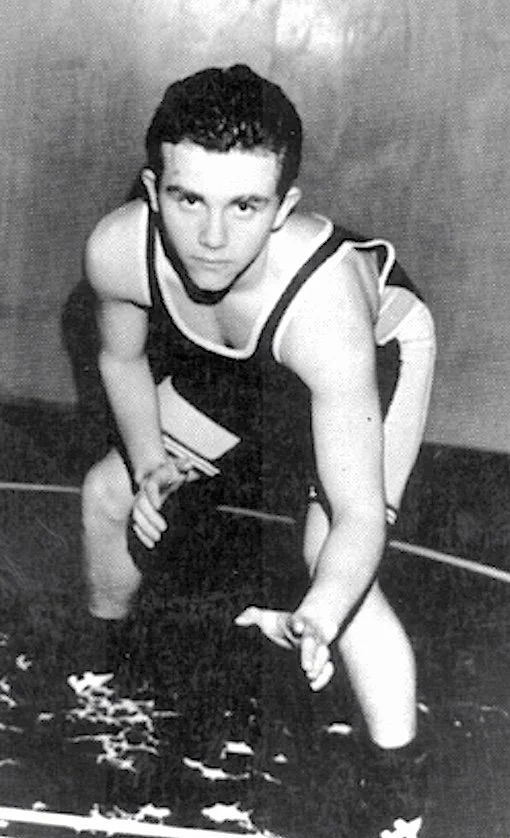
Greg Wells
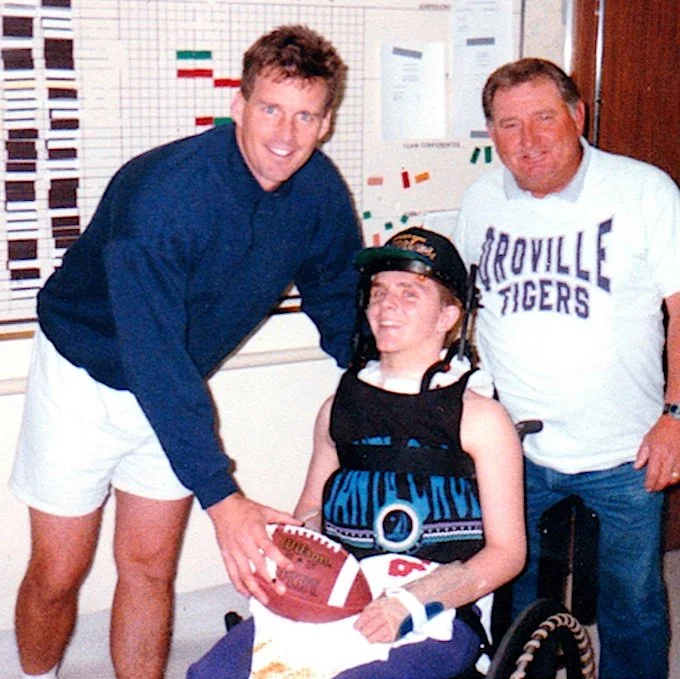
Greg Wells with former NFL quarterback Ken O'Brien.